Introducing DTA’s new course – on sedatives
- Aged Care Quality and Safety
- Benzodiazepines
- New Course
- Online Modules
- responsive behaviours
- Royal Commission
- Sedatives
Nurses, pharmacists and other allied health professionals wanting to learn more about the Appropriate use of benzodiazepines and other sedatives with people living with dementia can now take up the chance to do a new short online course developed by Dementia Training Australia (DTA) on this important topic.

Nurses, pharmacists and other allied health professionals wanting to learn more about the Appropriate use of benzodiazepines and other sedatives with people living with dementia can now take up the chance to do a new short online course developed by Dementia Training Australia (DTA) on this important topic.
The launch of the course is timely, with the over-use of psychotropic medication – such as benzodiazepines and other sedatives – being a key issue highlighted in the Final Report of the Royal Commission into Aged Care Quality and Safety.
International reviews also show that between 28% and 55% of people living in aged care homes are prescribed benzodiazepines on a regular or ‘when required’ basis.1 A study into six aged care homes within Western Australia found that 37% of residents were prescribed one or more benzodiazepines, 69% of whom had a diagnosis of dementia.2
The course’s lead author is Bronwen Wright, a Medication Management Consultant with DTA. She says: “Through our work at DTA with Australian residential aged care facilities, we’ve seen how important this issue is. We know that health professionals and care staff are keen to learn more about how they might better support residents through non-drug strategies, and how they can improve their practice if, as a last resort, a psychotropic medication is prescribed.”
Too often, sedatives are seen as the solution to a situation where a person with dementia is showing a changed or responsive behaviour. In fact, benzodiazepine and other sedative use is associated with serious adverse effects such as worsening responsive behaviours, impaired cognitive function, increased risk of falls and fractures, injury and/or death.
In many cases, prescribing a sedative is not the best or most appropriate strategy. Other options – such as pain relief, environmental changes, or facilitating engaging and meaningful activities – should be tried first, after reviewing the person’s individual needs and situation.
Now, thanks to DTA’s new course, practitioners can learn a systematic way to approach this complex issue. The course introduces learners to a range of tools and frameworks for reviewing the care of a person with dementia who is experiencing a responsive behaviour and working as a team to establish the best way forward.
The appropriate and thoughtful use of sedatives depends on developing a management plan and a withdrawal plan from the outset of the prescription.
The course takes learners through this process, with these four modules:

Introduction to appropriate use of benzodiazepines and other sedatives (1 hour)
Learn to balance the risks and benefits of using benzodiazepines and other sedatives in people living with dementia.

Target responsive behaviours (1 hour)
Learn about the target responsive behaviours that benzodiazepines and other sedative medications are commonly prescribed for.

Developing a management plan ( 1 hour)
Work through two case studies to develop an appropriate plan for managing a benzodiazepine and/or other sedative medication prescribed for a person living with dementia.

Developing a withdrawal plan (1 hour)
Work through two case studies to develop an appropriate plan for withdrawing a benzodiazepine and/or other sedative medication for a person living with dementia.
DTA is committed to continuing to grow the number of online courses on a variety of dementia-related topics to meet the needs of the multidisciplinary workforce.
To find out more, click here.
References
- Bourgeois J, Elseviers MM, Azermai M, Van Bortel L, Petrovic M, Vander Stichele RR. Benzodiazepine use in Belgian nursing homes: A closer look into indications and dosages. Eur J Clin Pharmacol. 2012 May; 68(5):833-844.
- Blogg LC, Suzuki N, Roberts M, Clifford RM. Prescribing benzodiazepines in residential aged‐care facilities. J Pharm Pract Res. 2016 Nov; 46:33-36.
Related Articles
02 Feb 2017
The Virtual Forest
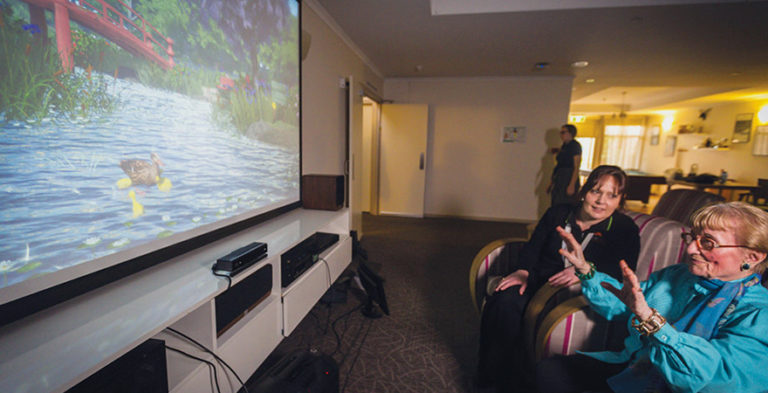
The Virtual Forest™ is a screen-projected game for people living with dementia. The virtual environment is designed to be calming and relaxing.

23 May 2018
Going beyond ‘tick the box’ training
An article from the Australian Journal of Dementia Care on DTA’s first year and Tailored Training Packages (TTPs), co-authored by DTA directors.