Learning Pathways is here: Your new dementia training guide, giving you personalised learning opportunities in seconds.
Start now at learningpathways.dta.com.au
Sign in or Create account
Contact us

Training

A range of dementia education, resources and events for the Australian workforce.

  • Browse all Courses
    • Behaviour
    • Dementia Awareness and Understanding
    • Dementia Diagnosis and Support
    • Diversity
    • Enabling Environments
    • Physical Wellbeing
  • Browse all Modules
  • Browse all Events
    • Virtual Classroom
    • Webinar
    • Workshop

Looking for a training solution for your organisation?
Explore our Commissioned Training

Learning Pathway Find and save personalised dementia training in seconds. Try it now!

Dementia Knowledge to Action Program

Become a guide who can lead, coach, and influence within your care setting.

Online and face to face learning, mentor support and ongoing endorsement with DTA available.

Free in all states and territories.

View program

Dementia Discovery

Are you new to dementia care?

Online short courses designed to increase your knowledge about dementia with tips on 'where to next' for training and resources.

Free to study.

View course

Resources

A range of free tools and practical resources you can use to help make a difference at your workplace.

  • Browse all resources
    • Application
    • Articles
    • Fact Sheet
    • Handbook
    • Print Materials
    • Toolkit
    • Video

Types of Support

DTA provides a range of services and support to organisations.

Find out more

  • Focus Areas
    • Changed Behaviour
    • Environments
    • Medication Management
    • Pain Management
  • Training Solutions
    • Environments Training Program
    • Tailored Training Programs
    • Train The Trainer

About

Find out more about Dementia Training Australia.

  • Learn More
    • About DTA
    • Aged Care Quality Standards
    • Australian Journal of Dementia Care
    • Dementia Education Standards Framework
    • Learning Pathways
  • Get Involved
    • Careers
    • Contact
Browse courses Sign in Contact us
Search

Popular search terms:

  • online courses,
  • tailored training,
  • consultancy,
  • membership,
Loading...

Thank you

  1. Home
  2. News
  3. Leading the change in medication management

Leading the change in medication management

16 Dec 2019 2 min read
  • aged care quality standards
  • antipsychotic medication
  • dementia
  • education and training
  • leadership
  • medication management
  • reducing medications
  • research
  • residential aged care
  • responsive behaviours

Kate Fulford and Andrew Stafford report on the findings from the first two years of the Dementia Training Australia Medication Management Consultancy

Nurse serving dementia patients
The name of this focus area is changing from "Responsive Behaviours" to "Changed Behaviour". You may see both terms while we transition our content to Changed Behaviour.

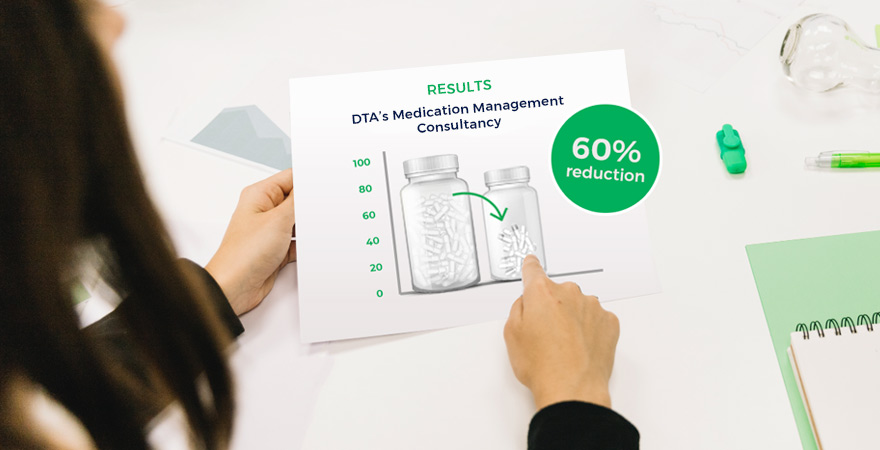
DTA’s Medication Management Consultancy is a pivotal pharmacist-led consultancy service reducing antipsychotic usage in residential aged care facilities across Australia.

Responsive behaviours are experienced by the majority of people living with dementia at some point throughout their journey with the condition.

For decades, antipsychotic medications have been used in residential aged care to alleviate responsive behaviours. This is despite these medications being of limited effectiveness for most responsive behaviours, and concerns regarding an increased risk for injury and death for a person with dementia who is prescribed an antipsychotic (TGA 2015).

There is also an increasing body of evidence that addressing responsive behaviours with non- pharmaceutical approaches is at least as effective as using antipsychotic medications (TG Ltd 2016). Consequently, most clinical guidelines that address responsive behaviours recommend that antipsychotic medications should only be considered when all non-medication approaches have failed, and only for severe symptoms of aggression and agitation. However, many residential aged care sites report difficulties in adhering to these guidelines due to various barriers. These include a lack of knowledge regarding the safe withdrawal of these medications, organisational processes that inadequately support decision making for responsive behaviour management, and lack of commitment to changing staff behaviour.

In response to this body of evidence, Dementia Training Australia (DTA) developed a pharmacist-led, evidence-based service that aims to embed knowledge and processes to optimise the use of antipsychotic medications for responsive behaviours. The Medication Management Consultancy (MMC) is a three-tiered process which benchmarks and then follows over time two key measures relating to antipsychotic use. These are: the number of residents prescribed antipsychotic medications for responsive behaviours; and staff knowledge about the appropriate use of psychotropic medications for responsive behaviours within the residential aged care facility (RACF).

The MMC has been undertaken by three large residential aged care organisations across Australia over the past two years, where considerable benefits in both measures have been identified. Across 10 locations, five RACFs have seen greater than a 50% reduction in the proportion of residents using antipsychotics, with up to 60% reduction facility-wide at one location, and 67% reduction across the dementia support unit (DSU) within another.
Article extract from external source. Read the full article

Share

Tags

  • aged care quality standards
  • antipsychotic medication
  • dementia
  • education and training
  • leadership
  • medication management
  • reducing medications
  • research
  • residential aged care
  • responsive behaviours

Share

Facebook Twitter LinkedIn

Related Articles

Two ladies sitting down at a computer

18 Aug 2015

Information On Dementia In Vietnamese: Talking Book

An online tool from RDNS for use with members of the Vietnamese community living with dementia to help them better understand and manage their condition.

01 Feb 2017

Prescription For Life: Supporting Those LIVING With Younger Onset Dementia

An interactive talking book designed to assist health workers to use a well-being approach to provide meaningful care for younger people living with dementia.

Loading...
Close
Back to top
1300 229 092
Stay Connected
Mailchimp
Visit our Facebook page Visit our Twitter page Visit our LinkedIn page Visit our Instagram page
  • Courses
    • Behaviour
    • Dementia Awareness and Understanding
    • Dementia Diagnosis and Support
    • Diversity
    • Enabling Environments
    • Physical Wellbeing
  • Events
    • Workshop
    • Virtual Classroom
    • Webinar
  • Resources
  • Types of Support
    • Medication Management
    • Changed Behaviour
    • Pain Management
    • Environments
    • Tailored Training
    • Environments Training Program
    • Train The Trainer
  • Australian Journal of Dementia Care
  • Dementia Education Standards Framework
  • Aged Care Quality Standards
  • Learning Pathways
  • Rural and remote Australia
  • Contact
    • Careers
    • Submit a DSA Referral
    • Help
Aboriginal flag Torres Straight Islander flag

DTA would like to show our respect and acknowledge the traditional custodians of these lands. We extend this respect to elders’ past, present and emerging, and to all Aboriginal and Torres Strait Islander peoples. We also pay respect to Aboriginal and Torres Strait Islander peoples living with dementia and their carers.

Aboriginal Artwork

© Copyright Dementia Training Australia®. All rights reserved. Dementia Training Australia is a training services program delivered by the University of Wollongong. It is supported by funding from the Australian Government under the Dementia Training Program. This website uses dementia terminology current at time of publication.

  • Privacy Policy
  • Terms and Conditions